
How AI Automation Helps Businesses Improve Efficiency and Productivity
Discover how AI automation helps businesses reduce repetitive tasks, improve operational efficiency, streamline workflows, and make smarter business decisions.
How AI Automation Helps Businesses Improve Efficiency and Productivity
Introduction
Businesses today are looking for smarter ways to manage their daily operations, reduce manual work, and improve productivity. Artificial Intelligence (AI) and automation are transforming how organizations handle repetitive tasks, manage information, and make decisions.
AI automation combines intelligent technologies with automated workflows to help businesses complete tasks faster, improve accuracy, and use resources more effectively.
What Is AI Automation?
AI automation uses artificial intelligence technologies to perform tasks that traditionally require human effort.
Unlike basic automation, which follows predefined rules, AI-powered automation can analyze information, recognize patterns, understand language, and support decision-making.
Examples include:
-
Automated customer support systems
-
Intelligent document processing
-
AI-powered data analysis
-
Automated email classification
-
Predictive business reporting
Key Benefits of AI Automation
1. Reduces Repetitive Manual Work
Employees often spend significant time on repetitive activities such as entering data, processing documents, organizing records, and responding to common queries.
AI automation can handle many of these tasks, allowing employees to focus on more important responsibilities.
2. Improves Operational Efficiency
Automated workflows help businesses process information faster and reduce unnecessary manual steps.
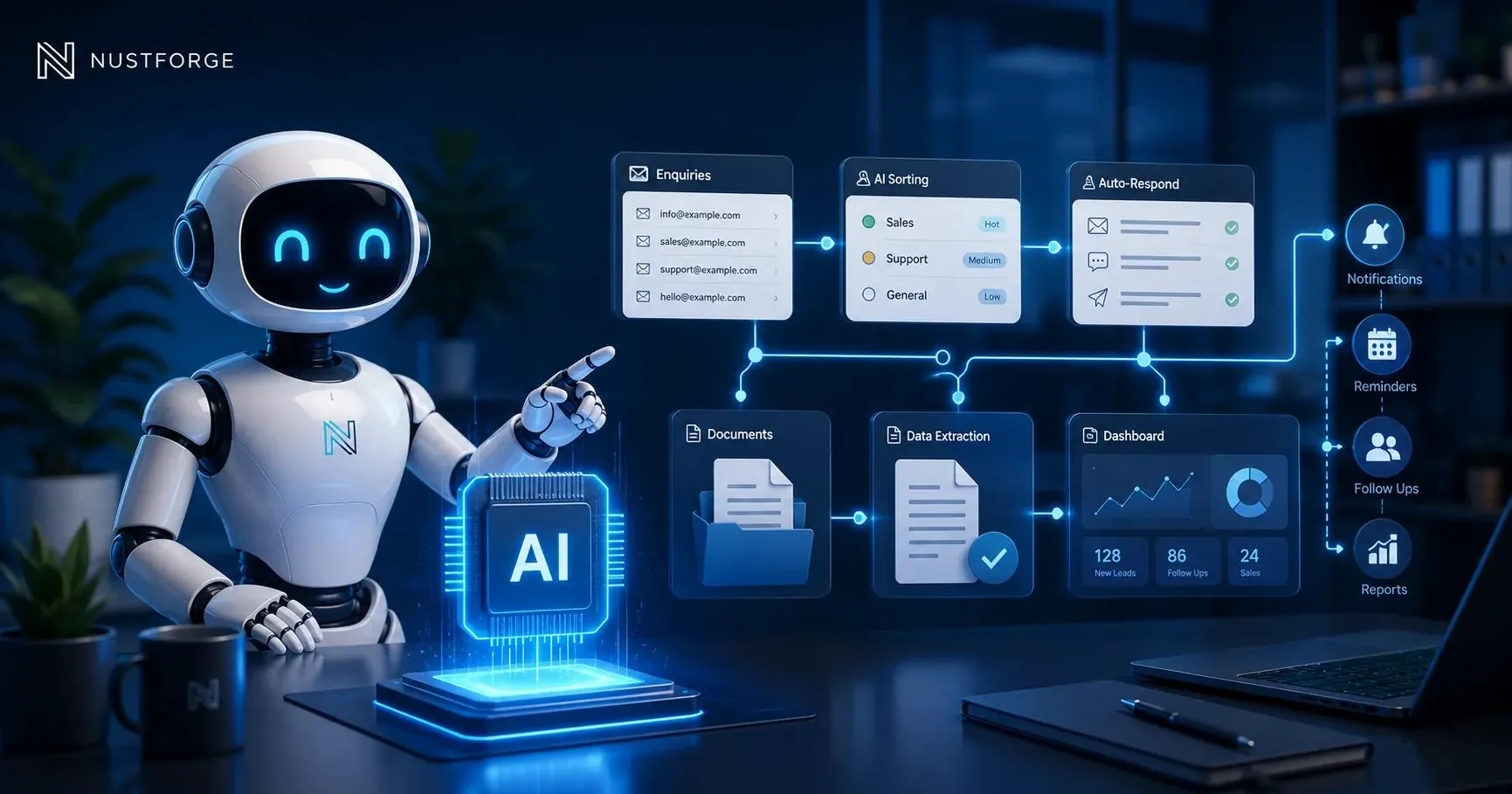
For example, an organization can automate invoice processing, customer request classification, and internal approval workflows.
3. Supports Better Decision-Making
AI systems can analyze large amounts of business data and identify patterns that may be difficult to recognize manually.
These insights can support business planning, performance monitoring, and operational improvements.
4. Enhances Customer Experience
AI-powered chatbots and virtual assistants can answer common questions, guide customers, and provide support outside regular business hours.
When properly implemented, these systems can improve response times while allowing human support teams to handle complex requests.
5. Reduces Operational Errors
Manual data entry and repetitive processes can introduce mistakes.
AI-assisted document processing and automated validation can help identify inconsistencies and improve data accuracy.
Practical Applications of AI Automation
Businesses can introduce AI automation across different departments.
Customer Support: Chatbots can handle frequently asked questions and route complex requests to support teams.
Finance: Automated systems can assist with invoice extraction, transaction categorization, and financial reporting.
Human Resources: AI tools can help organize applications, manage employee documents, and automate routine communication.
Marketing: Automation can support content workflows, customer segmentation, and campaign reporting.
Operations: Intelligent systems can help monitor workflows, process requests, and identify operational bottlenecks.
How to Implement AI Automation in Your Business
Successful AI implementation requires proper planning.
Step 1: Identify Repetitive Tasks
Start by identifying activities that consume time and follow predictable workflows.
Step 2: Define Business Goals
Determine what you want to improve, such as processing time, operational efficiency, customer response time, or data accuracy.
Step 3: Select Suitable AI Technologies
Choose technologies based on your requirements. Options may include machine learning, natural language processing, intelligent document processing, and AI-powered APIs.
Step 4: Integrate with Existing Systems
Ensure that automation solutions work with your existing business applications, databases, and workflows.
Step 5: Monitor and Improve
Regularly evaluate performance, review errors, collect feedback, and improve the automation process.
Challenges to Consider
AI automation also requires careful implementation.
Businesses should consider data privacy, security, integration complexity, implementation costs, and human supervision.
AI-generated outputs should be reviewed where accuracy and business decisions are important.
Conclusion
AI automation is becoming an important part of modern business operations. By automating repetitive activities, improving workflows, and supporting data-driven decisions, businesses can create more efficient working environments.
The right approach is to identify practical opportunities, select suitable technologies, and introduce automation gradually.
At Porulon Technologies, we explore AI-powered solutions, intelligent software development, and automation technologies to help businesses move towards smarter digital operations.
Want more AI tools, tricks, and custom solutions? Hit up Porulon Technologies – we got all the services to keep your 2026 game strong.
Explore our engineering capabilities in Coimbatore: AI Solutions, Machine Learning Development, Cloud & DevOps Solutions, Industrial IoT Automation, and Full-Stack Software Development.
About Author
PorulonTech Team
AI & Technology Solutions TeamPorulon Technologies is a technology company focused on artificial intelligence, machine learning, cloud computing, cybersecurity, enterprise software, and intelligent digital solutions. Our team explores emerging technologies and develops practical solutions that help organizations improve their digital capabilities.

Executive Scope & Technical Summary
Key architectural metrics, author attribution, and core executive takeaways.
Key Technical Takeaways
Technical Clarifications & Expert Q&A
Direct engineering answers to technical implementation questions.
Q1: What is the difference between automation and AI automation?
Basic automation follows predefined rules, while AI automation can analyze information, recognize patterns, and support more intelligent task execution.
Q2: Which businesses can benefit from AI automation?
Businesses of different sizes and industries can benefit from automating repetitive activities such as customer support, document processing, reporting, and data management.
Q3: Does AI automation replace employees?
AI automation is generally used to support employees by reducing repetitive work. Human supervision and decision-making remain important.
Q4: How should a business start implementing AI automation?
Start by identifying repetitive tasks, defining measurable goals, selecting suitable technologies, and testing automation through a small workflow.
Need Architectural Assistance For Your Project?
Consult with our principal engineers and solution architects to design, scale, or audit your enterprise tech stack.
Schedule Architecture Consultation